Ranking well used to mean being found
For a long time, the route from "I need a supplier" to "I'm on your website" was short. Someone typed a search, scanned ten blue links and clicked one. If you sat near the top, you were found.
That route has changed. Customers still search, but they now come across businesses in a wider set of places: the results page itself, map listings, answers written by chatbots, review sites and the recommendations of people they trust. Your website is increasingly one stop on a longer journey, not the starting line.
That matters if you judge success by your ranking. A position on Google tells you where you sit in one list. It doesn't tell you whether a Cambridgeshire buyer choosing between three businesses ever sees yours. That is what we mean by visibility: how often, and in what context, the right people come across your business wherever they happen to be looking.
Ranking and being found are not the same thing
On 21 October 2026 we searched for "best accountants in Cambridge" and took a screenshot of the whole first page. It's the kind of search a Cambridgeshire business owner might run when they need a supplier.
Figure 1. Where the first organic listing would once have sat, and where it sits today
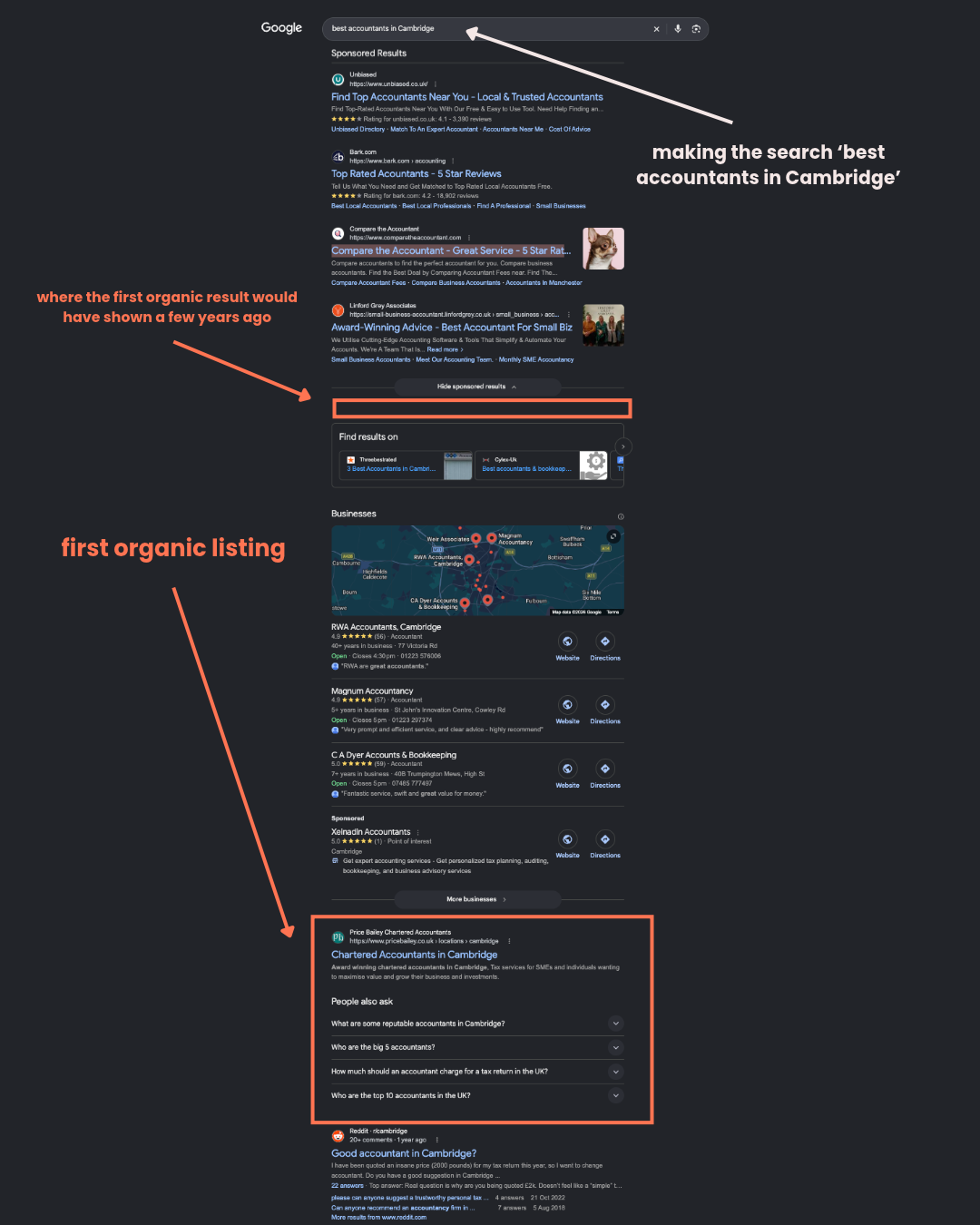
Count what appears before the first standard (organic) listing: sponsored results, a map pack and other search features, at least ten items in all. Only two organic listings appear on page one (it used to be at least 8 a few years ago). Someone scanning that page has met a shortlist of businesses before they reach what we'd traditionally call position one.
Then we changed the wording slightly, to "what are the best accountants in Cambridge", and the page changed again.
Figure 2. Reworded search, showing the AI Overview
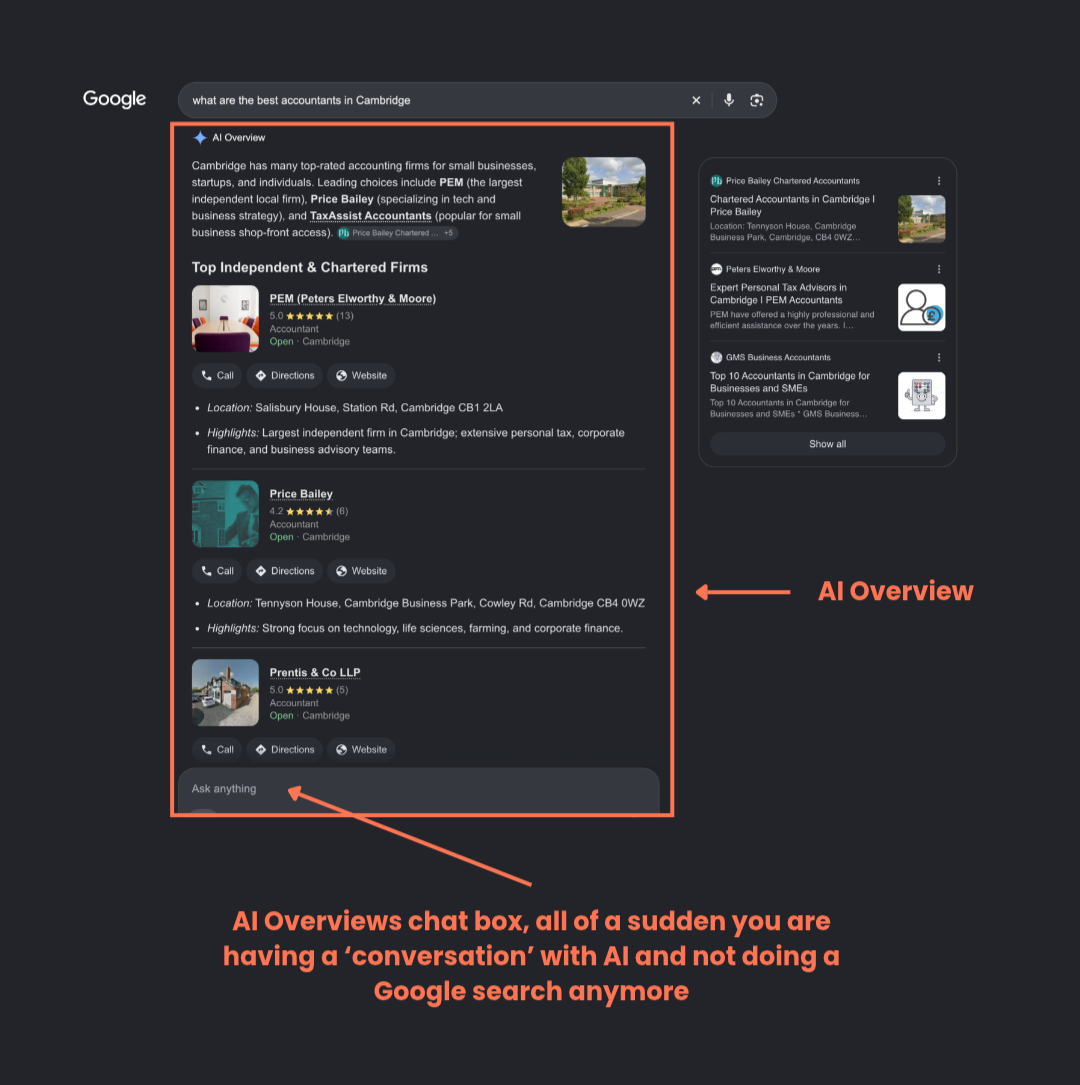
Google now showed an AI Overview recommending a different set of accountants, taking up over half of the first screen between the sponsored results and the rest of the page. Two near-identical questions produced two different pages, and a different cast of businesses.
A caution on all of this: one search, from one place, on one day, is an illustration and not a measurement. Results vary with the exact wording, the searcher's location and device, their search history and, for AI answers, sometimes the moment you ask. That's exactly why a handful of searches can't tell you how visible a business really is.
This isn't just our impression. In December 2025, Ahrefs analysed 300,000 keywords and estimated that AI Overviews cut clicks to the top organic result by about 58%. Their data was desktop-only and shows a correlation rather than proof, but the direction is clear: even when you hold the top spot, fewer people click through.
Ranking is your position within one list. Being found is whether you turn up, in a useful way, in the places your customers actually look.
The places that now count
There are six places where a customer might meet your business before they ever visit your website. You don't need to master all of them today, but you do need to know they exist.
- The Google results page, including AI answers. The page now often answers the question itself, with summaries, ads and comparison features sitting above the standard links.
- Maps and your Google Business Profile. For anything local, the map listing, reviews, photos and opening hours can decide the choice before your site is opened.
- Chatbots such as Claude, ChatGPT. Someone asks a question in plain language and gets a short answer or a recommendation instead of ten links. Your business is either mentioned or it isn't.
- Review sites and directories. Trade directories, industry lists and review platforms are where many buyers check that a business is who it says it is. I would include Reddit and Facebook Groups in this category too.
- LinkedIn and social media. For business-to-business buyers in particular, a company page and the people behind it are part of the due diligence.
- Word of mouth. Still the oldest route, and increasingly connected to the others: what people say about you offline shapes what is written about you online.
None of this means rankings have stopped mattering. A well-built website with good search performance still feeds most of these places. The shift is that it's no longer the only thing to check.
What to do this month
You don't need a new strategy before Christmas. You do need a realistic picture of where your visibility stands, and a few searches won't give you one. Start here:
- Be wary of the quick search. It's tempting to type your service into Google or a chatbot and see what comes back. But what you see depends on your location, your device, your search history and the exact words you use, and AI answers can change from one run to the next. It's a good way to get curious, not a way to measure visibility.
- Ask where your real enquiries came from. Look at your last five to ten enquiries. How did each person first hear about you? Chat to these people; are they early or late adopters of AI?
- Look beyond the ranking report. If your reporting only shows keyword positions, add impressions, click-through rate, branded searches and enquiries by source.
- Measure it properly. A fair picture needs the right searches and prompts, chosen to match your audiences and locations, repeated over time and compared with your competitors. That's the kind of work our Visibility Audit is designed to do.
Be inquisitive rather than alarmed. Businesses that understand where their audience looks are the ones that can decide where to invest.